

Licenses and Activities
Content
What is a feasibility study, exploration, local mineral activity and scientific research?
Many geological, environmental and technical studies are needed to prove the potential of a mine. A mineral exploration company therefore starts with a feasibility or exploration permit and then starts field work. Permits may be granted on land or in marine waters (not at depths greater than 200 metres).
Feasibility studies, exploration, local mineral activity, scientific studies and their general authorisation conditions can be found at www.govmin.gl.
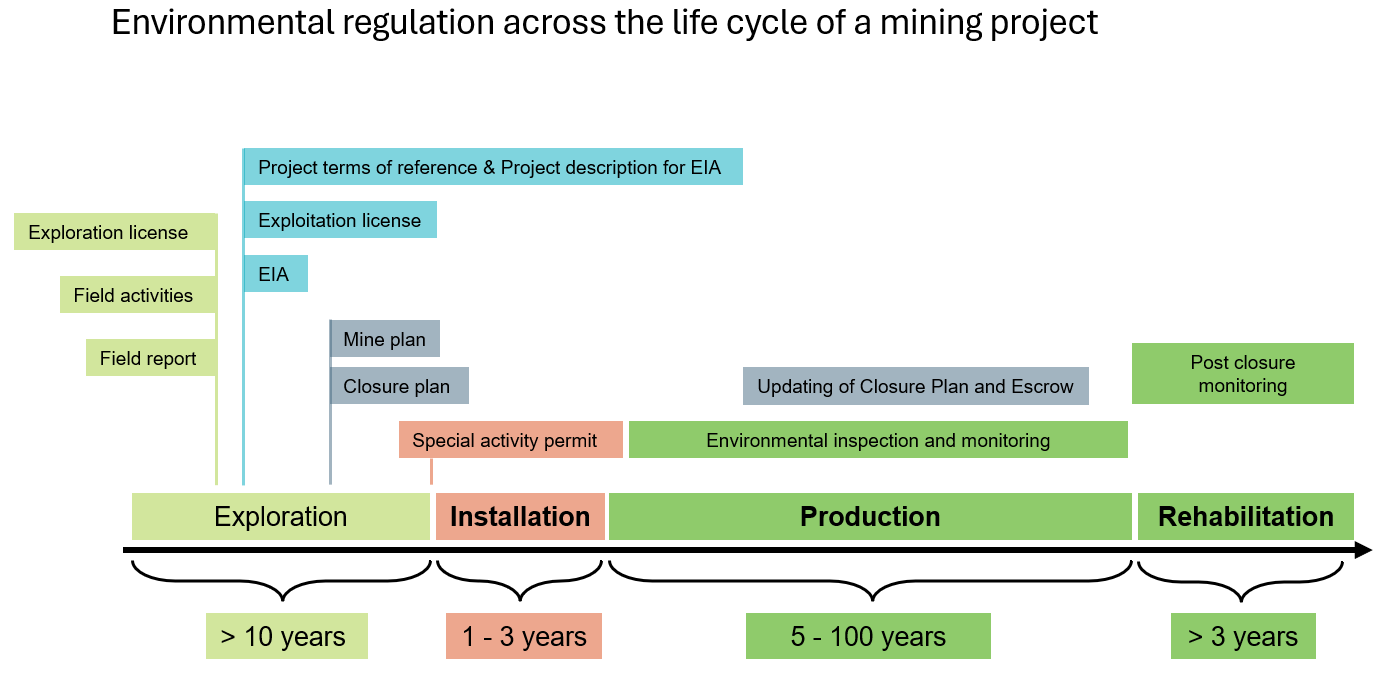
The illustration below provides an overview of the process from an exploration permit, all the way to decommissioning and final monitoring.
In the following section, you will find information on environmental protection in the types of activities typically related to the exploration phase. For more information on environmental protection in the construction, production and decommissioning phases, see the section ‘Towards exploitation’.
Common to all the following types of activities is that the Mineral Resource Authority must be informed about the planned work, and for some activities a permit must be applied for. Everything is collected in a field activity application, which is sent to the Licensing Department by 1 May of the year in which the activities are planned to be carried out. More information on application procedures and templates can be found on their website. Rules for fieldwork are also further described in this section.
The role of the Environmental Agency for Mineral Resource Activities (EAMRA) is to ensure that both the application process for new permits and activities in a permit area is subject to conditions that mitigate any impact on the area’s wildlife and use of the area. When EAMRA examines an application for field activities, particular attention is paid to what it is for an area that the activities may affect (see more under ‘protected and important biological areas’).
In addition, special attention is also given to activities which may be disruptive or influencing in the short or longer term. These are typically drilling, driving and blasting. But it can also be the use of drone, seismixes, process chemicals or the generation of residues and waste (see more under Rules for fieldwork and reporting and Guidelines for waste management from temporary work camps).
In many cases, these guidelines will set the framework for the activities applied for. In some cases, assessments of the specific application will have to be made. This will typically involve a dialogue between EAMRA, our advisers and the applicant, where more detailed information is often requested. An extension of the processing time of a field activity application can therefore be expected in some cases. Applicants are therefore recommended to familiarise themselves with NatureMap, and to apply well in advance, for activities in areas of importance for natural and animal life. After the end of the field season, the activities shall be described in a field report. This ensures that the Mineral Resource Authority has knowledge and evidence of what has actually been done in the field. Evidence (e.g. in the form of images) will often be beneficial in relation to field camps, temporary storage, discharge or waste management, and flight route and altitude in case surveys or frequent overflights of sensitive or protected area have been conducted. In some cases, EAMRA already requires this when approving the application for field activities. You can read more about reporting requirements and find templates on the Mineral Resources Authority’s website.
Pre-survey
A Preliminary Exploration Permit is a permit without the exclusive right to conduct surveys in a large area and without exploration obligations in the area (North, East or West Greenland). Preliminary Exploration Permits typically include overall geological surveys and mapping, e.g. from the air. Large-scale and concentrated activities on the ground are less frequent. EAMRA often focuses on disturbance of wildlife, such as bird colonies or migration routes, which can be disturbed by overflight, among other things.
Exploration
An exploration permit is for a smaller area than the pre-trial permit. Here, the company has the exclusive right to carry out exploration in the area and at the same time has investigative obligations.
Exploration activities can vary greatly in scope and potential for impact. Exploration typically takes place over a number of years and therefore also often involves the establishment of temporary work camps with more manning and equipment than the other types of permits described. Surveys are often targeted at locating and delimiting one or more particular resources, as well as other technical and geological studies relevant to the design and planning of possible exploitation. Activities therefore often include drilling and blasting, and thus also terrain driving, as well as the transport and storage of explosives, fuel and process chemicals (e.g. drilling additives). The exploration phase also typically includes initial environmental studies and baseline studies.
The other sections of this page on protected and important biological areas, Rules for fieldwork and reporting and Guidelines for Waste handling from temporary work camps cover all topics that are typical of EAMRA’s assessment of Field Activity Applications for exploration activities.
When a mining company reaches an advanced stage in its exploration and wishes to start baseline studies for use in a later EIA process, it is recommended that contact be made with the Environmental Protection Agency for Mineral Resource Activities (EAMRA). It can be of great importance for the later EIA process that the initial environmental studies and baseline studies are sufficiently well thought out and designed in relation to what needs to be studied and in what ways. Therefore, good time should be set aside for dialogue with EAMRA when planning these types of field activities. The Sample Collection Manual is available here.
Local Mineral Activity
Local mineral activity is also subject to separate conditions of protection, based on the same rules for field work as for exploration and exploration permits. Guidance on types of permits and activities covered by local mineral activity can be found on the Mineral Resources Authority’s website. Separate legislation highlighting the conditions under which local mineral activity deviates from other raw material activities can be found in the legislation section.
Local mineral activity typically involves few people with handheld tools and very small labour camps. In some cases, this may include driving on terrain and working with electric or fuel-powered handheld tools, which, like all other activities, must be applied for by the Mineral Resource Authority.
Local mineral activity always includes a very small geographical area. EAMRA’s focus is primarily on driving on terrain and the transport, storage and disposal of fuel and waste.
Material for the local construction market (dredging)
Dredging and collection of other material for the construction industry is also regulated under the Local Mineral Activities Act. These activities are subject to the same environmental requirements as local mineral activities and must therefore also be assessed, by the Environmental Agency for Mineral Resource Activities (EAMRA), before activities can start.
Applicants who are required to open a gravel pit or sand suction must fill in a special application form designed for activities which extract material for the construction industry. To access this application form, please contact the Licence Department at mlsa@nanoq.gl
Scientific studies
Scientific studies must be requested from the Licensing Department and are subject to the conditions laid down in the field rules. EAMRA treats applications for scientific studies as other raw material activities.
Scientific studies can consist of many different types of activities. For example, EAMRA is aware of whether the activities or the transport of personnel and equipment take place in protected or biologically important areas. Scientific surveys are sometimes carried out at sea, with a research vessel as a base. Surveys conducted at sea (seismic, sediment samples, or simply counts from a ship in propulsion) can be particularly disruptive for certain species during certain periods. Therefore, information on navigation routes, measuring equipment, strength and frequency are typically relevant in the application process for these types of activities.