

Towards mineral exploitation
Content

On the path to exploitation, and when a mining project looks promising, the mining company is required to describe and identify their project in a series of documents to be made available to the public.
In the first instance, this means that the company must draw up a project description and terms of reference. In the same period, the development of an Environmental Programme will start, to be designed in cooperation with the Environmental Agency for Mineral Resource Activities (EAMRA) and our scientific advisors. The environmental programme shall include a description of background studies on the environment (so-called baseline assessment) and project-related studies. Once drawn up, the environmental programme must be approved by EAMRA.
The purpose of the background studies is to describe the state of the environment prior to the construction and operational phases. The background studies are necessary to assess the possible environmental impacts expected from the project. Background data collected prior to mining also provide valuable standards for the decommissioning and rehabilitation plan. The aim of the project-related studies is to identify and quantify the project’s possible sources of pollution.
There are three different categories of residues after production of ores:
‘Waste rock’: Refers to the stone and rock adhering to the ore.
Tailings: Covers residues remaining after the removal of marketable minerals.
Process chemicals: The chemicals added to extract the ore.
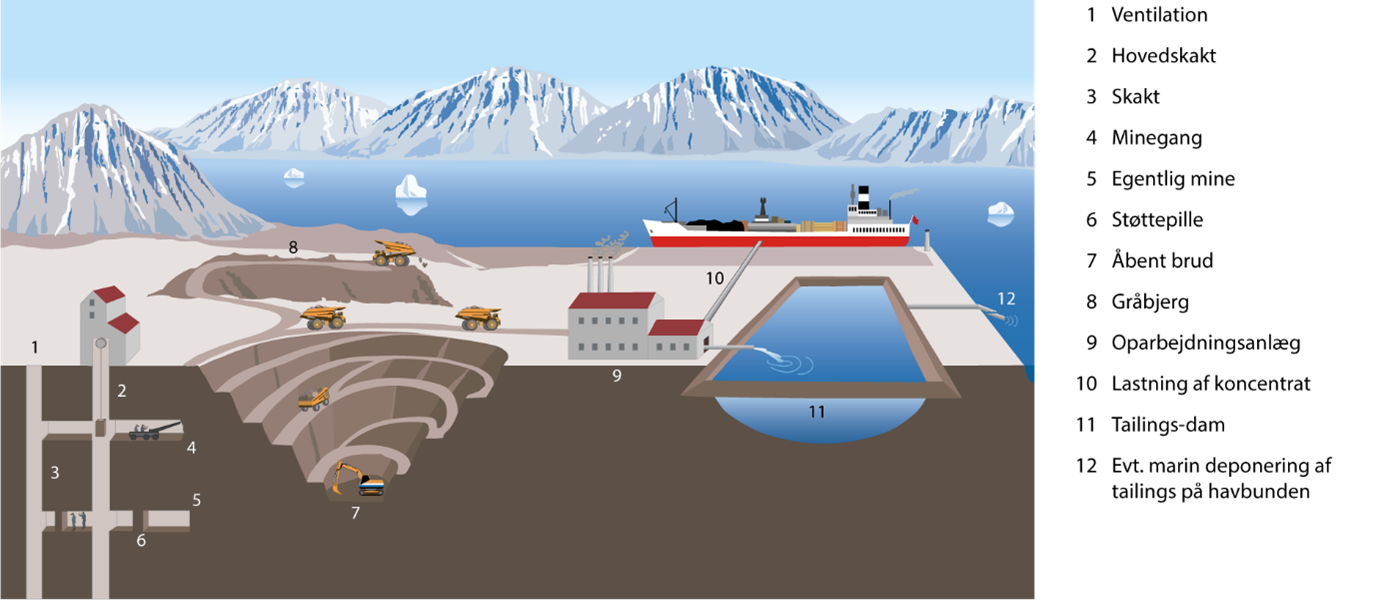
Sources of pollution include, for example:
The chemical composition of the ore that is broken;
Production residues, such as ‘Waste rock’, tailings and process chemicals;
Dust and other airborne particles from production
See the illustration below for the different environmental impacts caused by the mine. Figure from Environment and Raw Materials in Greenland, Preliminary title No 5 (2018)
In addition to project-related studies, the project description typically identifies studies to identify the local environmental and natural conditions (flora and fauna) that may be affected by the project. In addition, companies must also assess their climate footprint.
The project description and terms of reference must be submitted to a digital pre-consultation for 35 days on the website of the Government of Greenland. At the end of this process, the mining company will have to respond to the consultation responses received, as well as the Environmental Agency for Mineral Resource Activities’ (EAMRA’s) general assessment of the material. This forms the basis for the further process in which the company has to examine the identified topics in depth and incorporate them into an EIA (Environmental Impact Assessment) report.
The company must describe in the EIA how they will organise their mining project, including the expected environmental impacts. As part of the EIA, the company must describe how they will limit potential environmental impacts through the use of environmentally friendly technology, best practices and mitigation measures, as prescribed by the Mineral Activities Act. The mitigation measures are incorporated as conditions (environmental requirements) in the subsequent activity authorisation (for establishment and operation). In the EIA, the company must address the entire life cycle of the project and therefore also describe how the project is to be wound up and closed one day. Both during mining and after decommissioning, the environmental impact of the project shall be monitored and described in an environmental monitoring programme. The EIA is therefore used as a basis for formulating terms and conditions with which the company must comply in order to counteract potential environmental impacts.
An EIA report is often a very voluminous document, which is being prepared for several years, when the mining company is in constant dialogue with EAMRA. This is necessary in order for the material to adequately inform public consultation.
Find out more about public consultation here.
The Government of Greenland has adopted detailed guidelines on the EIA process, including, inter alia, requirements for background reports, language versions and the preparation of non-technical summaries, to ensure the best possible public participation in the consultation. You can read the EIA guidelines here.
As part of a comprehensive EIA report, a number of geochemical studies of the project’s sources of pollution, as described above, will most often be included. It is of particular importance that these studies are as thorough and accurate as possible when they are to be included in the EIA assessment. The DCE and the GN have drawn up recommendations for the determination of geochemical testing work up to and in connection with the preparation of an EIA report. The geochemical guidelines can be consulted here and used by EAMRA in assessing the geochemical studies and their adequacy.